

Knowledge · Founder’s Guide · 2026 Edition
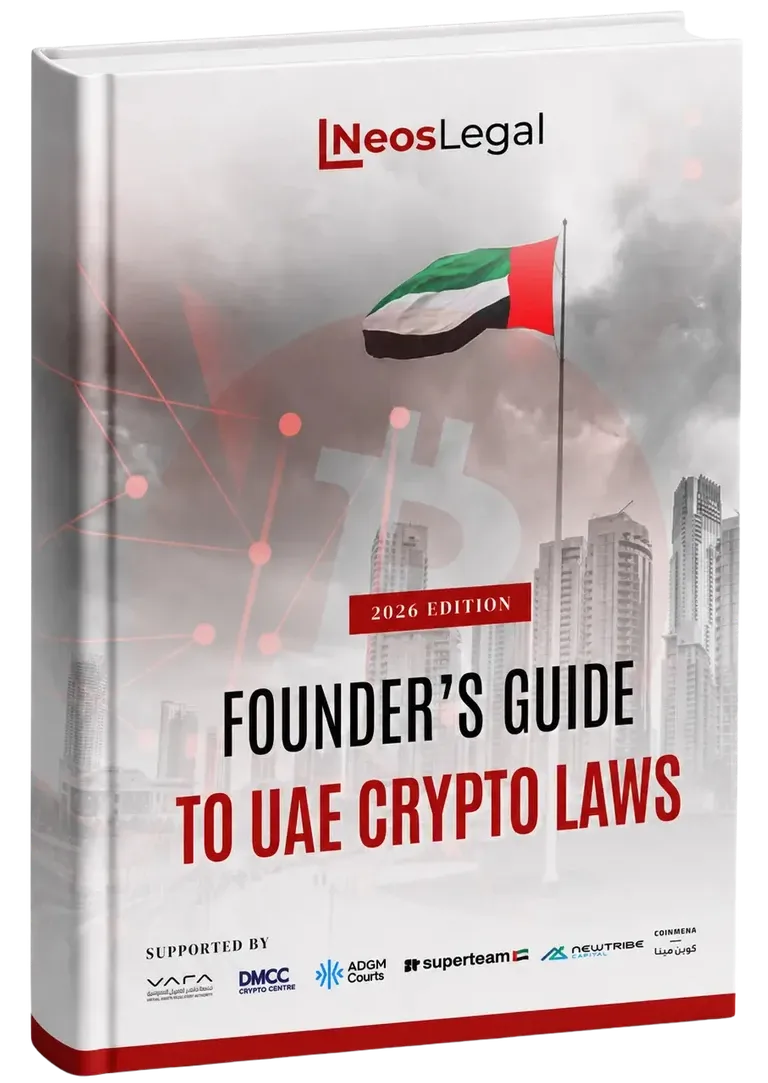
2026 Edition · Updated TODO[verify: edition date, source reads “[DD Month 2026]”] · Next edition January 2027
The legal blueprint for launching, licensing and running a crypto or Web3 business from the United Arab Emirates.
- 250 pages
- 12 chapters
- Free PDF
Quick Answer
The Founder’s Guide to UAE Crypto Laws is NeosLegal’s annual legal handbook for crypto and Web3 founders, now in its 2026 edition. It covers company formation, VASP licensing across the five UAE regulators (VARA, ADGM/FSRA, DIFC/DFSA, CMA and CBUAE), corporate tax and residency, Bitcoin holding structures, venture capital, hiring under UAE labour law, Golden Visa routes and Web3 dispute resolution. Written by Irina Heaver and Zainab Kamran. Free PDF.
Chapter 01 · Orientation
What Founders Need to Know First
- The UAE licenses virtual asset activity through five regulators: VARA in Dubai, ADGM’s FSRA and DIFC’s DFSA in the financial free zones, the federal Capital Market Authority, and the Central Bank of the UAE. Choosing between them is the first legal decision a founder makes, not an administrative step after incorporation.
- Not every crypto activity needs a VASP licence. Holding, trading for your own account, building software and issuing certain exempt tokens sit outside the licensing perimeter. The question is what you do for other people, not whether you touch crypto.
- The CMA is the federal authority for virtual assets in the UAE. It sets the perimeter, defines the classifications and holds the enforcement powers. VARA, established in 2022, is the CMA’s delegate within the Emirate of Dubai under Cabinet Decision No. 111 of 2022.
- The federal Capital Market Authority replaced the Securities and Commodities Authority on 1 January 2026 under Federal Decree-Laws Nos 32 and 33 of 2025. Any adviser still routing you to the SCA is working from a pre-2026 map.
- Operating without a licence risks fines up to AED 1 billion. Owners, directors and managers face personal criminal liability, and enforcement reaches any person targeting clients in the UAE from anywhere in the world.
- Individuals pay no income tax and no capital gains tax on crypto. Companies pay 9 percent corporate tax on profits above AED 375,000, subject to free zone qualifying income rules.
- Algorithmic stablecoins and privacy-enhanced tokens are prohibited at federal level, which means there is no route to authorisation for either anywhere in the UAE. TODO[verify: source carries a bare “[R]” marker on this bullet]
Chapter 02 · Jurisdiction
Why Do Crypto Founders Base in the UAE?
The United Arab Emirates is one of a small number of jurisdictions that decided to regulate virtual assets rather than tolerate or restrict them, and it did so early. Abu Dhabi Global Market published a crypto asset framework in 2018. Dubai created the world’s first standalone virtual assets regulator in 2022. The federal government has since rewritten its capital markets law to bring virtual assets inside a modern statutory perimeter.
The commercial features sit on top of that legal certainty. Founders get full foreign ownership, no capital controls, company formation measured in days rather than months, banking that has slowly opened to licensed virtual asset businesses, and long-term residency through the Golden Visa options. The country sits inside seven flying hours of most of Asia, Europe and Africa, which matters when your investors, your engineers and your users are on three continents.
Every UAE regime expects real presence: an office you occupy, senior people who live here, governance that meets in the country, and compliance functions staffed by named individuals. The UAE is a good place to build a regulated business and a poor place to build a letterbox. If you are planning market entry, start with the UAE crypto market entry roadmap.
Chapter 03 · Formation
How Do You Set Up a Crypto Company in the UAE?
There are four formation routes, and the choice constrains everything downstream: which regulator you can approach, how you are taxed, whether you can serve UAE customers, and what an acquirer will think of your structure in three years.
| Route | What it suits | What it constrains |
|---|---|---|
| Financial free zone (ADGM, DIFC) | Regulated financial activity, institutional clients, funds, custody, and anything that benefits from an English common law system and its own courts. | Higher cost and higher substance expectations. Regulatory approval is a precondition. |
| Commercial free zone (DMCC, RAKEZ, IFZA and others) | Operating companies, development entities, service businesses and holding structures. Fast to form, wide activity lists. | A commercial free zone is not a regulator. A free zone trade licence permits an activity commercially; it does not authorise regulated virtual asset services. |
| Mainland | Businesses serving UAE customers directly, retail-facing operations, and anything requiring onshore contracting. | Emiratisation quotas apply above headcount thresholds. Federal regulatory perimeter applies in full. |
| Offshore (RAK ICC, JAFZA Offshore, and non-UAE vehicles) | Holding, intellectual property, token issuance vehicles and foundation structures sitting above the operating entity. | No UAE substance and no UAE residency. Works as a layer in a structure, never as the structure. |
The most common early mistake is treating the free zone choice as a procurement decision made on price and speed. It is a regulatory decision. A founder who incorporates in a commercial free zone, then discovers the business model requires a Federal VASP licence, has bought the wrong entity in the wrong place. The UAE crypto company setup page covers formation in detail.
DMCC is a free zone, not a regulator. A DMCC trade licence with a crypto activity listed on it does not authorise regulated virtual asset services.
Chapter 04 · Licensing
Which UAE Regulator Licenses Your Activity?
Five authorities regulate virtual asset activity in the UAE. They are not tiers of one system. They are separate regimes with separate rulebooks, separate application processes and separate supervisors, and a licence from one does not travel to another.
Route selection turns on three questions: what the activity actually is, who the customers are, and which legal system your investors and counterparties expect. A global exchange serving institutional clients rarely lands in the same place as a consumer wallet or a treasury holding vehicle. The five-regime comparison sits on the VASP licence UAE hub, with regulator detail on the VARA licence Dubai , ADGM crypto licence and CMA federal crypto licence UAE pages.
| Regulator | Territory | What it licenses | Legal system |
|---|---|---|---|
| CBUAE | Federal, payment tokens | Dirham payment token issuance, payment token custody and transfer, and payment token conversion services. | UAE federal law |
| CMA | Federal, across the emirates outside the financial free zones and outside of Dubai | Dealers, brokers and exchange platforms, security tokens and tokenized commodity contracts. Replaced the SCA on 1 January 2026. | UAE federal law |
| VARA | Dubai, excluding DIFC | The full virtual asset service set: exchange, custody, broker-dealer, lending and borrowing, advisory, management and investment. | Dubai law, purpose-built virtual assets regime |
| ADGM (FSRA) | Abu Dhabi Global Market | Virtual asset multilateral trading facilities, custody, dealing, advising and managing. Fiat-backed stablecoin issuance is regulated as money transmission. | English common law, own courts |
| DIFC (DFSA) | Dubai International Financial Centre | Investment services in recognised crypto tokens only, plus tokenized investment products through the tokenization sandbox. | English common law, own courts |
Before you choose, look at who has already been licensed and for what. The UAE VASP Licence Tracker records every licensed entity across the five regimes, updated monthly, and is the only public dataset of its kind in the country.
Chapter 05 · Licence categories
Which Licence Category Matches Your Business Model?
Regulators licence activities, not companies. Two businesses that describe themselves the same way in a pitch deck can sit in different categories, and a business that adds one feature can cross into a category it is not licensed for.
Exchange and trading
Operating an order book, matching trades or running a multilateral facility. The core licence and the most heavily supervised.
Learn moreCustody
Holding client assets or controlling private keys on their behalf. Segregation, key management and insurance requirements dominate the application.
Learn moreBroker-dealer
Agency execution, principal dealing and over-the-counter desks. The category most often reached accidentally by treasury and OTC operations.
Learn moreAdvisory, management and investment
Recommending, managing or investing on behalf of others.
Learn moreTransfer and settlement, and payment tokens
Movement and conversion of value, which pulls the Central Bank into scope alongside the virtual asset regulator.
Learn moreMarketing and promotion
Not a licence in itself, but a regulated perimeter with its own penalties.
Learn moreMarketing deserves particular attention because it catches businesses that are not otherwise in scope. Under VARA’s 2024 Marketing Regulations, unlicensed entities are prohibited from promoting virtual asset services to UAE residents. That covers paid social, influencer arrangements, event sponsorship and any public promotion aimed at the UAE market, and it reaches foreign entities that market in dirhams or use localised content and local influencers. Fines run to AED 10 million for serious or repeat breaches.
Chapter 06 · Tokens
How Are Tokens Classified, and When Do You Need a Legal Opinion?
Classification is the question underneath every token project, and each UAE regulator answers it differently.
VARA classifies by licensing consequence. Category 1 covers Asset-Referenced Virtual Assets and Fiat-Referenced Virtual Assets, known commercially as real-world asset tokens and stablecoins. Category 2 covers everything else, including utility tokens and non-fungible tokens, and distribution is restricted to licensed broker-dealers and exchanges. Exempt Virtual Assets, which include non-transferable and closed-loop redeemable tokens, carry no pre-issuance requirement.
The CMA divides assets into security tokens, commodity contract tokens and virtual assets. ADGM’s FSRA and DIFC’s DFSA apply economic substance tests to decide whether a token is a commodity, a security, a utility or outside the perimeter entirely. In ADGM, fiat-backed stablecoins must be fully backed one for one and are regulated as money transmission. In DIFC, they are treated as fiat crypto tokens and require recognition before use in financial services.
Two prohibitions apply across every UAE jurisdiction without exception: algorithmic stablecoins, and privacy-enhanced tokens such as Monero and Zcash.
A written legal opinion is what turns a classification view into something a third party can rely on. Tier-1 exchanges require one before listing. Banks and payment providers ask for one at onboarding. Investors ask for one in diligence. NeosLegal has issued more than 250 token legal opinions with a 100 percent Tier-1 exchange acceptance rate. See UAE token launch for the opinion process, UAE RWA tokenization for asset-backed issuance.
Chapter 07 · Tax
Is Crypto Taxed in the UAE?
For individuals, no. There is no personal income tax and no capital gains tax in the UAE, which means salary, trading profits, staking rewards, non-fungible token sales and long-term appreciation are untaxed at the personal level.
For companies, yes, at 9 percent on profits above AED 375,000, effective for financial years beginning on or after 1 June 2023. Free zone entities may access a 0 percent rate on qualifying income, but the conditions are strict: the activity must be a qualifying one, dealings with the UAE mainland are restricted, and adequate substance must sit in the free zone. Fail a condition and the exemption falls away for the year and the four that follow.
| Rate | Applies to |
|---|---|
| 0% | Personal income and capital gains for individuals. Qualifying income for compliant free zone entities. |
| 0% | Small Business Relief: resident businesses with revenue of AED 3,000,000 or less, by election, extended to 2029. |
| 9% | Corporate profits above AED 375,000. |
| 15% | Domestic minimum top-up tax for in-scope multinational groups. TODO[verify: source marks this row “[verify]” — confirm effective date and the revenue threshold, or cut the row] |
| Exempt | Value added tax on virtual asset transactions, retroactive to 1 January 2018. |
Two points founders regularly miss. A natural person carrying on a business in their own name, for example independent advisory or consulting work, becomes subject to corporate tax once turnover from that activity exceeds AED 1,000,000 in a calendar year. And multinational groups above the global revenue threshold face a domestic minimum top-up tax of 15 percent.
Small Business Relief: a resident business with revenue of AED 3,000,000 or less in the current and every previous tax period can elect to be treated as having no taxable income, which means no corporate tax and a simplified filing. The relief was due to end in 2026 and has been extended to 2029. The election has to be made, and free zone entities claiming qualifying income cannot use it.
Value added tax is a settled question: the Federal Tax Authority confirmed in 2024 that virtual asset transactions are exempt from VAT, applied retroactively to 1 January 2018. Structuring for tax and structuring for regulation pull in different directions often enough that they should be designed together. See crypto tax UAE .
Chapter 08 · Bitcoin
How Is Bitcoin Treated Under UAE Law?
Bitcoin is a virtual asset under federal law and is recognised as property, which is the point that matters for enforcement, inheritance and security interests. Buying, holding, trading and investing in Bitcoin are lawful activities for individuals and for companies.
Using Bitcoin as a means of retail payment is treated separately from using it as an investment asset, and payments in virtual assets for goods and services are restricted, however this is a developing area of law. That restriction does not touch holding, trading or treasury use.
Holding structures matter more than most founders expect. A personal or family-owned entity in ADGM, DIFC or RAK ICC can hold Bitcoin with clear title, clean succession and a governance layer that survives the founder. Abu Dhabi has also become a significant mining jurisdiction, with large-scale operations running on sustainable and nuclear power. Mining, custody, treasury and fund structures each carry different licensing consequences: see UAE Bitcoin structuring and UAE crypto family office .
Chapter 09 · Capital
How Do Crypto Funds and Venture Capital Structure in the UAE?
The UAE has become a base for crypto-native capital, both for managers raising funds and for founders raising rounds. The vehicles are mature: ADGM Qualified Investor Funds for managers who want a light-touch professional-investor regime, DIFC funds where the investor base expects a DFSA-supervised wrapper, master-feeder structures pairing an offshore feeder with a UAE master, and special purpose vehicles for single-asset and co-investment deals.
Fund managers should note that managing a fund is itself a regulated activity, distinct from any virtual asset licence the fund’s assets might imply. A manager can need authorisation even where the fund holds nothing but liquid tokens.
On the raising side, the guide includes a curated list of Web3-native venture capital firms active in the UAE, with the stage and thesis of each. For fund formation, see UAE crypto fund formation .
Chapter 10 · Structures
When Do You Need an Offshore Vehicle Alongside the UAE Entity?
Not every part of a Web3 project belongs in a UAE company. Protocol governance, token issuance and open-source development often sit better in a foundation or a non-profit vehicle, with the UAE entity as the operating and employing company underneath.
The UAE offers two native options. ADGM’s DLT Foundation grants legal personality, contracting capacity and the ability to hold assets, and was built specifically for decentralised structures. RAK DAO provides a more flexible Association model aimed at Web3-native organisations. Outside the UAE, Cayman foundation companies, British Virgin Islands holding companies, Panama and Marshall Islands vehicles each remain common in token structures for reasons that are usually investor-driven rather than tax-driven.
The design question is where value, control and risk sit, and whether the answer survives contact with a regulator, an exchange listing committee and an acquirer’s diligence team. See offshore Web3 DeFi structuring . Projects with a gaming or wagering component have a further layer, since two regulators can apply at once: see UAE GameFi and iGaming licence .
Chapter 11 · People
What Are the Rules for Hiring a Crypto Team in the UAE?
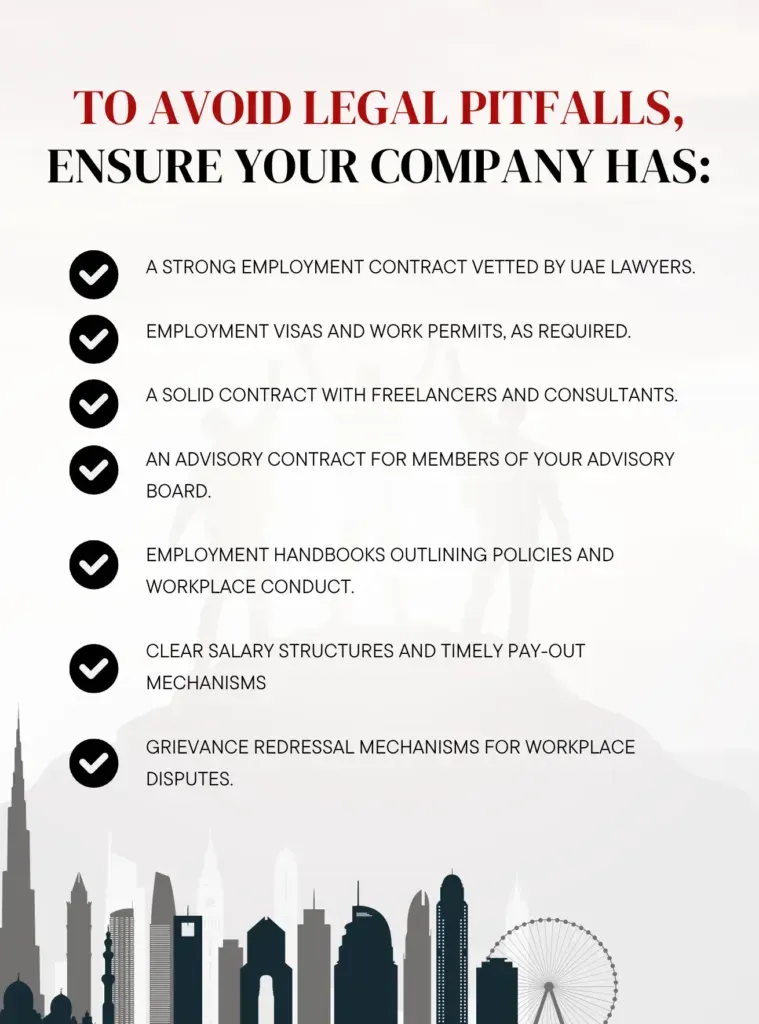
Scaling a crypto company here is a labour law exercise as much as a recruiting one. Every employee needs a work permit, a compliant employment contract, health insurance and an Emirates ID. Beyond that, the obligations depend on where the employing entity sits.
Mainland employers and some free zone employers fall under MOHRE, which means payroll runs through the Wage Protection System, end-of-service gratuity accrues under the Labour Law once an employee completes a year of continuous service, and mainland companies above the headcount threshold carry Emiratisation obligations with real financial consequences for missing them.
DIFC and ADGM run their own employment regimes and sit outside MOHRE. DIFC replaced end-of-service gratuity with DEWS, a funded workplace savings scheme with monthly employer contributions, and ADGM applies its own regulations.
Chapter 12 · Disputes
How Are Web3 Disputes Resolved in the UAE?
Founders think about disputes after they have one. The venue is decided long before that, in the governing law and dispute resolution clause of contracts signed in year one.
- Mediation
Fast, confidential and increasingly encouraged in commercial matters. Often the right first step where the commercial relationship has value worth preserving.
- International arbitration
DIAC in Dubai and the LCIA offer enforceable awards and neutrality for high-value cross-border matters, which suits token and investment disputes with parties in several countries.
- DIFC and ADGM Courts
English common law, English-language proceedings, and judges familiar with financial and technology disputes. ADGM Courts allow parties to opt into their jurisdiction without a physical UAE presence.
- Onshore civil courts
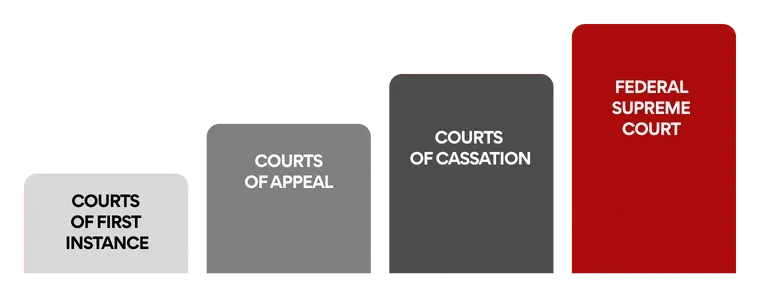
Abu Dhabi, Dubai and Ras Al Khaimah courts are the default for mainland matters, in Arabic and under codified law, structured as Courts of First Instance, Courts of Appeal and Courts of Cassation, with the Federal Supreme Court at the top.
The 2026 edition
What Is in the 2026 Edition?
The 2026 edition is a full rewrite of the federal chapters. The Capital Market Authority replaced the Securities and Commodities Authority on 1 January 2026 under Federal Decree-Laws Nos 32 and 33 of 2025, which rewrote UAE capital markets law, raised the penalty ceiling for unauthorized activity to AED 250 million, and extended enforcement to any person targeting clients in the UAE from anywhere in the world. Any guide written before that date describes a regulator that no longer exists.
What Changed from the 2025 Edition
- The federal regulator chapter rewritten for the CMA transition, with the new penalty and extraterritoriality provisions.
- Token classification updated across all five regimes.
- A new chapter on real-world asset tokenization following the property title developments in Dubai.
- Refreshed venture capital list and updated fund vehicle comparison.
- Corporate tax section updated for the free zone qualifying income conditions and the top-up tax for large groups.
“Ten years of the same questions, asked by thousands of founders. At some point it became obvious we should just write the answers down. In plain English, with as little jargon as we could manage. Ambitious founders deserve to start from knowledge rather than from guesswork, and giving them that has been the point of the last ten years.”
See who holds a licence today in the UAE VASP Licence Tracker, updated monthly across all five regimes.
Open the tracker Get the 2026 Edition
250 pages, 12 chapters, written for founders in simple English. Free and delivered by email.
Instant delivery. We also send a crypto law alert when a UAE regulator does something that changes an answer in this guide. Unsubscribe any time.
Frequently Asked Questions
-
It is NeosLegal’s annual legal handbook for crypto and Web3 founders operating in the United Arab Emirates, covering company formation, VASP licensing, token classification, tax, residency, hiring and disputes in one document. The 2026 edition is current.
-
Yes. The full guide is delivered by email at no cost. There is no paid tier and no upsell.
-
The 2026 edition. Editions are published annually at this same URL, so bookmarks, citations and links remain valid across editions.
-
All five: VARA in Dubai, ADGM’s FSRA and DIFC’s DFSA in the financial free zones, the federal Capital Market Authority, and the Central Bank of the UAE. DMCC is a free zone, not a regulator.
-
The federal Capital Market Authority took over on 1 January 2026 under Federal Decree-Laws Nos 32 and 33 of 2025. Penalties for unauthorized activity now reach AED 250 million, and enforcement extends to any person targeting clients in the UAE from any jurisdiction.
-
It depends on how the token is classified and how it is distributed. Category 2 virtual assets can only be distributed through licensed broker-dealers and exchanges, so most issuance involves a licensed party even where the issuer is not itself licensed.
-
Individuals pay no income tax and no capital gains tax on crypto. Companies pay 9 percent corporate tax on profits above AED 375,000, subject to free zone qualifying income rules. Crypto transactions are exempt from VAT retroactively to 1 January 2018.
-
Yes. It covers the ADGM DLT Foundation and the RAK DAO Association models, and how offshore vehicles such as Cayman foundations interact with a UAE operating entity.
-
Irina Heaver, UAE Crypto Lawyer and founder of NeosLegal, with Zainab Kamran, Associate. The same authors write the UAE chapter of the Chambers Blockchain and Crypto-Assets 2026 Global Practice Guide.
-
No. It is general information about UAE law and does not create a lawyer-client relationship. Specific structuring decisions require advice on your own facts.